Dacre monument viwed from above

Gregory Fiennes, Lord Dacre of the south, and his wife Ann Sackville

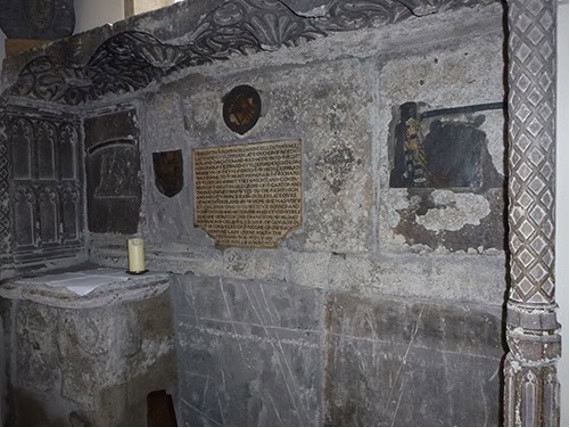
On the South side is the Dacre Monument (1595) to Gregory Fiennes, Lord Dacre of the south, and his wife Ann Sackville, who inherited the Chelsea properties of Sir Thomas More and founded the Emanuel Charity. Recently cleaned, conserved and restored.

Find Out More
Dacre monument viwed from above

Gregory Fiennes, Lord Dacre of the south, and his wife Ann Sackville

The detail is elaborate and curious. There is the shield of arms upon the architrave, surmounted by scales, a winged skull and an hourglass, symbolising Judgement, Death, and Immortality; there are flaming urns to right and left, symbols of immortality again; there are pyramids, the proper Elizabethan term for the small obelisks before us, the “starry pointing pyramid” of Hilton’s epitaph on Shakespeare, and the emblem since classical days of eternity.

As an adult Ann was an avid advocate of education for both sexes, as she found many schools for boys and girls in Tothill Fields, Westminster, one of which is still running, this is Emanuel School, begun in 1594 and now in Battersea.

Recently cleaned, conserved and restored.

Northumberland

Jane Guildford Duchess of Northumberland

Jane Dudley, Duchess of Northumberland, the mother of Queen Elizabeth’s favourite Leicester, and the grandmother of Sir Philip Sidney, She was the mother-in-law of Lady Jane Grey  and was an English courtier. She was the wife of John Dudley, 1st Duke of Northumberland, and mother of Guildford Dudley and Robert Dudley, 1st Earl of Leicester.

Find Out More
Northumberland

Jane Guildford Duchess of Northumberland

The mutilated tomb (1555) in the southeast corner of the More Chapel commemorates Jane Dudley (nee Guildford), Duchess of Northumberland.

Having grown up with her future husband, who was her father’s ward, she married at about age 16. They had 13 children.

Jane Dudley served as a lady-in-waiting at the court of Henry VIII and was a close friend of his final wife, Catherine Parr. 

In the spring of 1553, the Duchess of Northumberland became the mother-in-law of Lady Jane Grey, the ‘9-day queen’ whom the Duke of Northumberland unsuccessfully tried to establish on the English throne after the death of Edward VI. Mary I being victorious, the Duchess sought frantically to save her husband’s life. Notwithstanding his and her son Guildford’s executions, she was successful in achieving the release of the rest of her family by befriending the Spanish noblemen who came to England.

More Monument

Sir Thomas More

The monument to Sir Thomas More (d1535) stands in the Sanctuary against the South wall.  venerated in the Catholic Church as Saint Thomas More, was an English lawyer, judge, social philosopher, author, statesman, and noted Renaissance humanist. He also served Henry VIII as Lord High Chancellor of England.

Find Out More
More Monument

Sir Thomas More

The monument to Sir Thomas More (1532) stands in the Sanctuary against the South wall. The inscription was composed by Sir Thomas More himself and edited by Erasmus, commemorating his first wife and expressing the wish that he and his second wife should be buried in the same tomb.

Dedicated to his two wives, Joanna (Jane) Colt and Alice Middleton.

More paid close attention to the religious upbringing of his children, and well as their general education. He made sure that his three daughters received as fine an education as his son, at a time when few girls were educated.

He was beheaded in 1535 and his head was fixed upon a pike over London Bridge for a month, according to the normal custom for traitors. More’s daughter Margaret later rescued the severed head which is now believed to rest in the Roper Vault of St Dunstan’s Church, Canterbury. His body was buried at the Tower of London, in the chapel of St Peter ad Vincula in an unmarked grave.

Unsubstantiated tradition states that his daughter, Margaret Roper, brought his body to Chelsea for burial at the Old Church.

Carved by Mary Gillick, installed 1935

Margaret Roper, Magdalen Herbert, Mary Astell, Elizabeth Blackwell

In abiding memory of four Chelsea women distinguished by their learning and piety. Dedicated by University Women of Crosby Hall and by members of the Chelsea Society. Carved by Mary Gillick, installed 1935

Find Out More
Carved by Mary Gillick, installed 1935

Margaret Roper, Magdalen Herbert, Mary Astell, Elizabeth Blackwell

Carved by Mary Gillick, installed 1935

Margaret Roper (née More) (1505–1544) was an English writer and translator, she was the first non-royal woman to publish a book she had translated into English

Magdalen Herbert d1627 an intimate friend of John Donne’s and mother of the poets Sir Edward Herbert and George Herbert.

Mary Astell (1666–1731) was one of the first English women to advocate the idea that women were just as rational as men, and just as deserving of education, she founded a charity school for girls in Chelsea

Elizabeth Blackwell d1758. She made a significant contribution to medical knowledge and to the art of botanical illustration. Her multi-volume work, ‘A curious herbal’, published in the 1730s, was an invaluable resource for doctors and apothecaries in the 18th century and beyond. ‘A curious herbal’ is one of the earliest botanical books to have been compiled by a woman.

Thomas More statue with birds in flight, outside Chelsea Old Church

Sir Thomas More

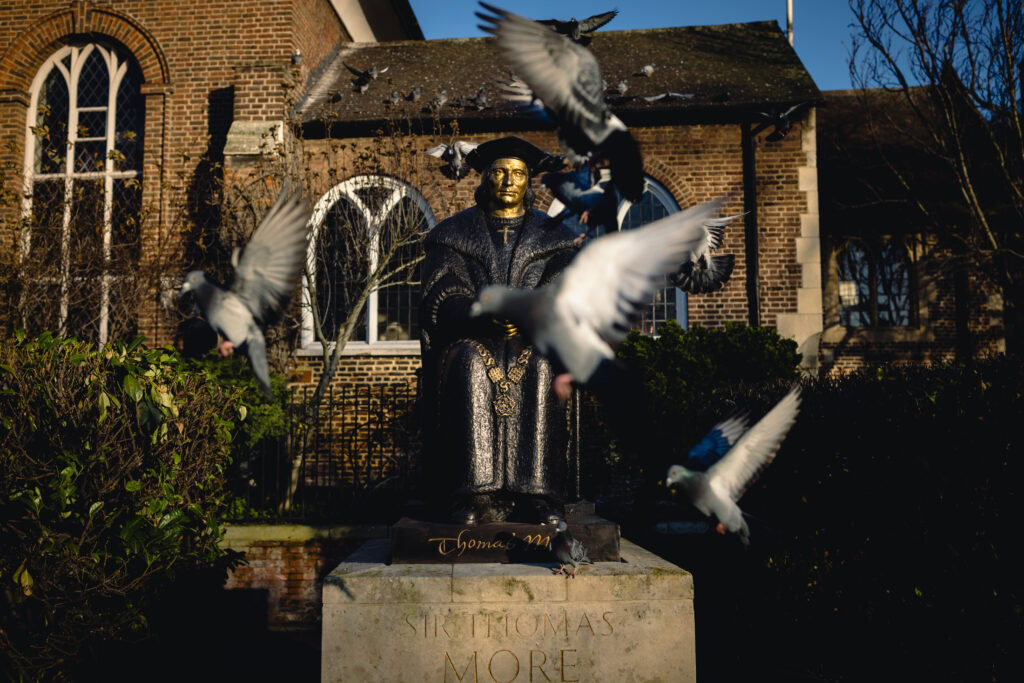
The statue of Sir Thomas More, which sits outside the Church, is by L. Cubitt Bevis and was erected in 1969.

Find Out More
Thomas More statue with birds in flight, outside Chelsea Old Church

Sir Thomas More

The Royal Standard of Henry Tudor is on the back of the chair, the chain of office is on his lap but the crucifix is round his neck. His gaze is gently turned slightly to the left, his last journey down river to the Tower.

Inscription {On the base of the statue, in script that is based on his signature:} Thomas More

{On the plinth, clockwise, starting at the front:}

Sir Thomas More 1478 + 1535

Scholar

Saint

Statesman

The gold face of More is difficult to explain. Cubitt was influenced by the Buddhist sculptures he saw each day as he passed the Society entrance above his studio, he also admired Byzantine art that used colour and gold in the icons. Gold leaf was selected and at that time it was a warm gold, says Clive Duncan, sculpture assistant.

Sir Hans Sloane

Sir Hans Sloane (1660-1753) He purchased Henry VIII’s manor house and later More’s old house.

Find Out More

Sir Hans Sloane

Sir Hans Sloane (1660-1753) He purchased Henry VIII’s manor house and later More’s old house, but it was not until 30 years later that he made Chelsea Place his home. He was buried at Chelsea Old Church, his wife had died nearly 30 years earlier so the monument erected in 1763 in memory of Sir Hans also included his wife. It stands in the south east corner of the churchyard.

A physician, naturalist, and collector, with a collection of 71,000 items which he bequeathed to the British nation, thus providing the foundation of the British Museum, the British Library and the Natural History Museum, London.

The British Museum Friends had a plaque placed in the chancel in 2003 in memory of Sir Hans.

monument plaque celebrating the reconcecration of the church by queen mother and remembering the five firewatchers killed when church bombed

Fire Watchers – Henry Frankland, Yvonne Green, Michael Hodge, Sidney Sims and Frederick Winter 

During the Blitz two mines attached to parachutes drifted near the front of the church, one exploded, also setting off the other and in the resulting blast, most of the Church was destroyed and five out of the six Fire Watchers were killed,

Find Out More
monument plaque celebrating the reconcecration of the church by queen mother and remembering the five firewatchers killed when church bombed

Fire Watchers – Henry Frankland, Yvonne Green, Michael Hodge, Sidney Sims and Frederick Winter 

On the night of 16th/17th April 1941, Yvonne was not originally meant to have been on duty but had swapped shifts with one of her colleagues. At about 1.00 a.m., whilst the raid was at its height, she and five of her Fire Watching colleagues set off on a patrol along Chelsea Embankment. Whilst one of the team, a Mr Mallett was examining some shell fragments in the road, he became aware of something floating down behind him. He quickly realised that this was a Parachute Mine and shouted at the others to run. His colleagues were about twenty feet away from him and began to run towards Chelsea Old Church. Mr Mallett was running too quickly to turn the corner and follow them, so instead ducked for shelter behind a fire alarm cover. At about the same time, a second Parachute Mine descended between the still running group of five Fire Watchers and the Church. This mine exploded, also setting off the first and in the resulting blast, most of the Church was destroyed and five out of the six Fire Watchers were killed, the only survivor being Mr Mallett.

Sir Robert Stanley

Sir Robert Stanley, son-in-law of Sir Arthur Gorges

Find Out More

Sir Robert Stanley

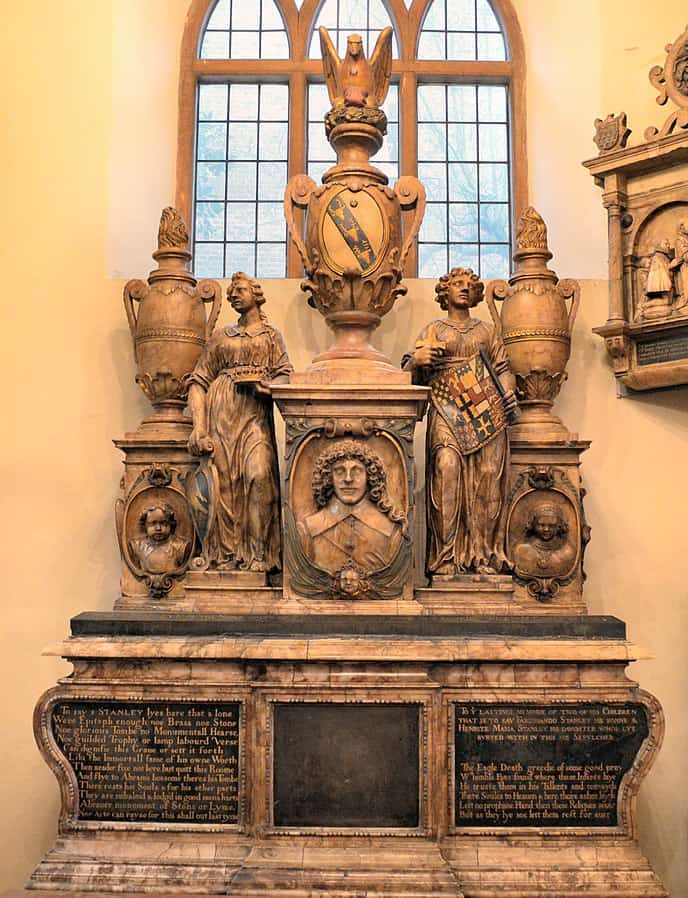
At the East end of the Lawrence Chapel is the monument (1632) to Sir Robert Stanley, son-in-law of Sir Arthur Gorges, whose brass is in the North wall of the More Chapel.

His monument is one of the most idiosyncratic of the 1630’s, its appearance somewhat marred by the later application of brown varnish, probably in the C19th.

On the right inscription:  “To ye Lastinge Memorie Of Two Of His Children / That is To Say Fardinando  Stanley His Sonne & / Henrite Maria Stanley  His Daughter Who  Lye / Buryed Within This Sepulcher”.    Then a poem: “The Eagle Death greedie of some good prey / Wth nimble Eyes found where these infants laye / He truste them in his Tallents and conveyde / There Soules to Heaven & here their ashes layde / Lett no prophane Hand then these Reliques sever / But as they lye so lett them rest for ever”.

Sara Colvile monument

Sara Colvile

Sara Colvile (1632), is depicted rising in her grave clothes from the tomb.

Find Out More
Sara Colvile monument

Sara Colvile

Sara Colvile (1632), eldest daughter of Sir Thomas Lawrence is also commemorated in the Lawrence Chapel , and is depicted rising in her grave clothes from the tomb.


The inscription is as follows:

SACRED
to ye blessed memory of that
vnstayned copy & rare example
of all virtve
SARA
wife to Richard Colvile of Nevton
in ye Ile of Ely in ye covnty of
Cambridg Esq davghter to
THOMAS LAVRENCE
of Iver in ye covnty of Bvckingha Esq
who in ye 40th yeare of her
age received ye gloriovs reward
of her constant piety
being ye happy Mother of 8 sons
and 2 davghters.
Wonder not (reader) how this stone
Should be so smooth & pure: there’s one
That lyes within’t, by whose fayre light
It shines so cleere & looks so bright
The Cutters art could only give
A forme unto’t: no power to live;
Nor shall it ever loose this grace
Till she arise & leave the place;
For losse of whome ye mournfull Vrne
Shall fire, and to Cynders turne.

Thomas Lawrence

Sir Thomas Lawrence, Goldsmith and Merchant Adventurer of the City of London

Find Out More

Thomas Lawrence

Sir Thomas Lawrence (1593), Goldsmith and Merchant Adventurer of the City of London, is commemorated in his chapel.

Henry James

He became one of his generation’s most well-known writers and remains so to this day for such works as The Portrait of a Lady and The Turn of the Screw

Find Out More

Henry James

An American novelist and naturalized Englishman, Henry James was an important figure in transatlantic literary culture of the day. Born on April 15, 1843, in New York City, Henry James became one of his generation’s most well-known writers and remains so to this day for such works as The Portrait of a Lady and The Turn of the Screw. Having lived in England for 40 years, James became a British subject in 1915, the year before his death. He died on February 28, 1916, in London, England.

J Woolley, J C Griffith, J W Lambe and William Bruce

J Woolley, J C Griffith, J W Lambe and William Bruce who drowned in the Thames.

Find Out More

J Woolley, J C Griffith, J W Lambe and William Bruce

Who were drowned opposite this Church through the swamping of their boat in a squall of wind 1839

Drawing of bray monument

Lord Bray

Sir Edmund, first Lord Bray (1539) and heir to the Sir Reginald Bray who was Master of Works to Henry VII


Find Out More
Drawing of bray monument

Lord Bray

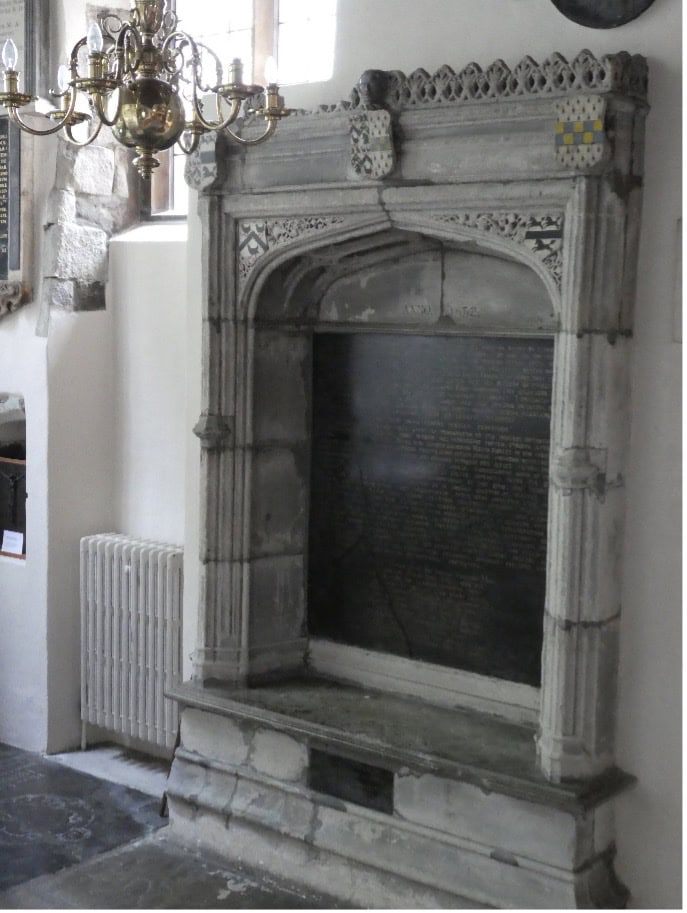
On the North side of the Chancel in a recess is the tomb of Sir Edmund, first Lord Bray (1539) and heir to the Sir Reginald Bray who was Master of Works to Henry VII and in charge of the building of Henry VII’s Chapel at Westminster and St. George’s Chapel at Windsor.

Chelsea is the last place in which to look for medieval monuments, since it was the scene, in September 1539, of the most remarkable act of iconoclasm in England.

In that month, we are told, “all the notable images, unto the which were made any especially pilgrimages and offerings, as the images of our Lady of Walsingham, Ipswich, Worcester, the Lady of Wilsdon, the rood of Grace of our of Boxley, and the image of the rood of Saint Saviour at Bermondsey, with all the rest, were brought up to London, and burnt at Chelsey, at the command of the foresaid Cromwell”.

Chelsea then, was most unlikely to retain any tomb bearing figures of saints or the like, even if such formerly existed, and, as Weever further says that he examined the tombs of Edmund and Reginald Bray, and found them “so defaced that I can find no further remembrance neither of these two nor of the time of their death”, we may reasonably ascribe their state to the Puritan fanaticism of the next generation, against which Elizabeth directed several edicts, since the Puritan view of monuments was that they were “remaines of Antichrist, papisticall and damnable”. So this monument significant in that it highlights an important phase in the history of monuments but as an art form less significant.

Lady Jane Cheyne

Lady Jane Cheyne (1669), daughter of the Duke of Newcastle, and a great benefactor to this Church and the village of Chelsea. The memorial is the work of the Italian artist Bernini’s studio.

Find Out More

Lady Jane Cheyne

On the North side of the Nave is the memorial to Lady Jane Cheyne (1669), daughter of the Duke of Newcastle, and a great benefactor to this Church and the village of Chelsea. The memorial is the work of the Italian artist Bernini’s studio, carved by one of Gian Lorenzo Bernini’s favourite sculptors Antonio Raggi.

Lord and Lady Cheyne lived in Henry VIII’s manor house and their memory is cherished in Chelsea, their name being commemorated in Cheyne Walk. Her life through the Civil War was an eventful one before she married Charles Cheyne and came to Chelsea. She purchased the manor, and was a great benefactor to the village, bearing part of the expense of rebuilding the church roof.

Drawing of Jervoise monument, large ceremonial archway

Richard Jervoise.

Triumphal arch (1563) commemorating Richard Jervoise.

Find Out More
Drawing of Jervoise monument, large ceremonial archway

Richard Jervoise.

Within the West arched entrance of the Lawrence Chapel is the triumphal arch (1563) commemorating Richard Jervoise.

The tomb is in the form of a Roman triumphal arch and is probably the only one of the type in England. Italian detail, notably in the shell niches, is used side by side with the purely classical frieze, mouldings end entablature; but the author is not known.

Patricia Casson plaque , she was daughter of Dame Sybil Thorndike

Patricia Casson 

Patricia Casson 1914 -1992 wife of John Casson 1909-1999, she was daughter of Sybil Thorndike.

Find Out More
Patricia Casson plaque , she was daughter of Dame Sybil Thorndike

Patricia Casson 

1914 -1992, garden monument. The engagement is announced between Lieutenant John Casson, R.N., son of Mr Lewis Casson and Miss Sybil Thorndike, the famous actress, and Miss Patricia Chester-Master, of Shanghai. 4 April 1934. Patricia Casson’s father-in-law, Lewis, was a famous actor and director, more relevant to CoC at is that he also helped his father build pipe organs

She edited ‘My Dear One’ a book published in 1984 that was a collection of love letters between Sybil Thorndike’s parents Agnes Bowers and Arthur Thor

The monument plaque for David Heatly

David Heatley

David Heatley 1803 Agent Victualler for the fleet who supplied Nelson with live oxen.

Find Out More
The monument plaque for David Heatly

David Heatley

David Heatley 1803 Agent Victualler, south aisle. The agent victualler for the fleet, wrote to Nelson offering to supply live oxen and agreed for 40 live oxen to be ready on Friday week next – also for 3 or 400 chests of lemons.

During the Corsica campaign between 1794 and 1796 Heatley had spent most of his time travelling round the western Mediterranean, buying cattle through the British consul John Udney, arranging for the use of bread ovens in Naples and on Elba, and even dealing with the Pope through the British consul at Rome.

The monument plaque for Thomas Hurd

Thomas Hurd, Frederica and Samuel Hurd

Captain Thomas Hannaford Hurd (d1823) was an officer of the Royal Navy.  Hurd Peninsula is named after him due to his role in the discovery of Antarctica.

Frederica (d1824), was the daughter of Lieutenant-General William Wynyard. She married Samuel Proudfoot Hurd in 1815 at St. Luke’s, Chelsea

Find Out More
The monument plaque for Thomas Hurd

Thomas Hurd, Frederica and Samuel Hurd

South chancel. Captain Thomas Hannaford Hurd (d1823) was an officer of the Royal Navy, who rose to the rank of captain, becoming the second Admiralty hydrographer, a Superintendent of Chronometers and a Commissioner for the discovery of longitude. Hurd Peninsula is named after him due to his role in the discovery of Antarctica. Frederica (d1824), was the daughter of Lieutenant-General William Wynyard. She married Samuel Proudfoot Hurd in 1815 at St. Luke’s, Chelsea
drawing of medieval gathering around big bonfire of burning books

Monuments destroyed

In 1539, we are told, “all the notable images, were brought up to London and burnt at Chelsey,

Find Out More
drawing of medieval gathering around big bonfire of burning books

Monuments destroyed

In 1539, we are told, “all the notable images, unto the which were made any especially pilgrimages and offerings, as the images of our Lady of Walsingham, Ipswich, Worcester, the Lady of Wilsdon, the rood of Grace of our of Boxley, and the image of the rood of Saint Saviour at Bermondsey, with all the rest, were brought up to London, and burnt at Chelsey, at the command of the foresaid Cromwell”, (Weever’s Funerall Monuments,1631, p.l11)

Richard Stewart Jones plaque, he made the rebuilding of the church his ardent cause

Richard Stewart-Jones

Richard Stewart-Jones who honoured God and made the rebuilding of this church his ardent cause.

Find Out More
Richard Stewart Jones plaque, he made the rebuilding of the church his ardent cause

Richard Stewart-Jones

His memorial reads as follows: “In memory of Richard Stewart-Jones who honoured God and made the rebuilding of this church his ardent cause. He believed that what is right is never impossible and what is beautiful is worth fighting for, even to death. Merry in spirit and kind in deed, he was loved by a multitude of friends. He died in 1957, aged forty three years.”

His obituary in the Times of 26th September 1957: “Mr Richard Stewart-Jones, who died suddenly in London on Sunday at the age of 43, was well known in Chelsea for devoted work on behalf of numerous causes, especially the Chelsea Society, of which he was honorary secretary for several years, and the affairs of the Old Church, whose restoration after bombing he worked so hard to bring about “

He was the owner of several of the architecturally well-known houses at the western end of Cheyne Walk, including most of Lindsey House.

Mary Bolney 

Mary Bolney outlived both her husbands and had 14 children

Find Out More

Mary Bolney 

located in South Aisle west

Near this Place Lyes the Body of

Mrs Mary Bolney Widow, late of Little

Chelsey, Daughter of Bartholow Smith

Esqre of the Soke in Winchester. She was

twice Married, first to John Wybarnd Esqre.

of Hawkwell in Kent by whom she had

2 Sons & 3 Daughters, & afterwards to

Geo Bolney of Bolney Esqre by whom

3 Sons & 6 Daughters, & died in the 88th

Year of her Age Anno Domini 1716. 

She outlived both her husbands and had 14 children but that is about all there is recorded about her, her brother became a priest, then one of the four Bishops appointed in the reign of James II. Her family (Smith) were Recusant (defined as English Roman Catholics of the time from about 1570 to 1791 who refused to attend services of the Church of England and thereby committed a statutory offence), but she seems to have broken the family mould and been buried under the auspices of the Church of England here at Chelsea Old Church

Mathew Squire Plaque with error in wording

Mathew Squire

Matthew Squire Esq Rear Admiral of the Red of his Majesty’s Royal Navy.

Find Out More
Mathew Squire Plaque with error in wording

Mathew Squire

 An elliptical tablet of white marble, 1800 south aisle wall, inscribed as follows with unfortunate wording

Near this Spot is Interr’d the remains of Matthew Squire Esq Rear Admiral of the Red of his Majesty’s Royal Navy who departed this Life 22 January 1800 Aged 55 Years his Virtues are to well known to be recorded here being sincerely regretted by all his Friends.

Peter, George, Carew, William and Shrubb Elers

Peter 1753, George 1784, Carew 1821, William 1888 and Shrubb Elers 1900.

Carew Thomas’ grandson married Meri Ihaia Whakamairu, the daughter of a Maori chief in New Zealand

Find Out More

Peter, George, Carew, William and Shrubb Elers

Carew Elers 1755-1821: His son also Carew Thomas was vicar of Bickenhill and 17th in direct descent to Edward I, his grandson, also Carew Thomas married Meri Ihaia Whakamairu, the daughter of a Maori chief in New Zealand, he also joined the Klondike gold rush, returned to NZ where he was an advocate in the then native land court.

Leonard Frederick Harrold plaque whose wife paid for the restoration of the More chapel in 1931

Leonard Frederick Harrold

Leonard Frederick Harrold 1858-1924 the London Agent for one of the largest shipping agents in Australia

Find Out More
Leonard Frederick Harrold plaque whose wife paid for the restoration of the More chapel in 1931

Leonard Frederick Harrold

1858-1924 the London Agent for one of the largest shipping agents in Australia, with massive warehouses in Port Adelaide and Port Augusta and Port Pirie, and branches in Broken Hill, Sydney and Melbourne. He visited Adelaide in 1875. More Chapel restored by his wife 1931

Paul Bedford plaque, a comedian and singer died 1901

Paul Bedford

Paul Bedford was an English comedian and in 1833 he joined as a singer the company at Covent Garden

Find Out More
Paul Bedford plaque, a comedian and singer died 1901

Paul Bedford

(1792?–1871), was an English comedian, south aisle. The first printed mention he played Don Guzman in Giovanni in London. Then playing with Kean in Richard III which appears in his “Recollections”. Bedford accepted an offer from Sir Henry Bishop for Drury Lane, his first appearance as Hawthorn in ‘Love in a Village’. Bedford played Bernhard, head ranger of the forest, in Soane’s version of Der Freischütz. Soon afterwards he was promoted to Caspar in the same opera. Through successive managements Bedford kept a position chiefly due to his vocal capacity. In 1833 he joined, still as a singer, the company at Covent Garden under Macready, appearing in Fra Diavolo, Gustavus III, and other operas.

During many years he played second low-comedy parts at the Adelphi, Bedford was a sound and trustworthy actor of the rollicking sort. His figure and his voice formed a conspicuous portion of his stock in art. Recalling his singing in Adelphi farces, in a whole series of which he appeared, one is apt to forget that he obtained reputation in Lablache’s great character of Don Pasquale. He had been above fifty years on the stage. He died of a dropsical at Lindsey Place, Chelsea, and was buried in Norwood Cemetery

William Frend De Morgan

William de Frend Morgan was an English potter, tile designer and novelist.

Find Out More

William Frend De Morgan

Located in Lawrence Chapel (16 November 1839 – 15 January 1917) was an English potter, tile designer and novelist. A lifelong friend of William Morris, he designed tiles, stained glass and furniture for Morris & Co. from 1863 to 1872. His tiles are often based on medieval designs or Persian patterns, and he experimented with innovative glazes and firing techniques. Galleons and fish were popular motifs, as were “fantastical” birds and other animals. Near the beginning of his career De Morgan was commissioned to install the tiles in the Arab Hall of Leighton’s house, designed by architect George Aitchison also he was commissioned by P&O to provide tile decorations for twelve new liners 

In 1872, De Morgan set up a pottery works in Chelsea where he stayed until 1881. His inventive streak led him to spend hours designing a new duplex bicycle gear and also lured him into complex studies of the chemistry of glazes, methods of firing, and pattern transfer.

He turned his hand to writing novels, and became better known than he ever had been for his pottery. His first novel, Joseph Vance, was published in 1906, and was an instant sensation in the United States as well as the United Kingdom. This was followed by An Affair of Dishonour, Alice-for-Short, and It Never Can Happen Again. The genre has been described as ‘Victorian and suburban’.