 Main Menu
The Church has stained glass through the ages, including the oldest in London, apart from Westminster Abbey.
A Rediscovered Stained Glass Window
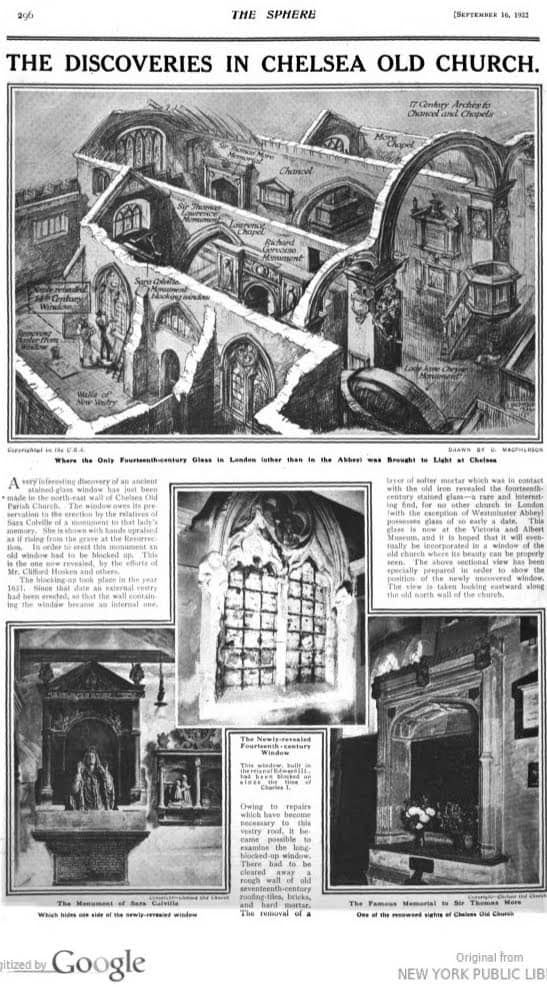
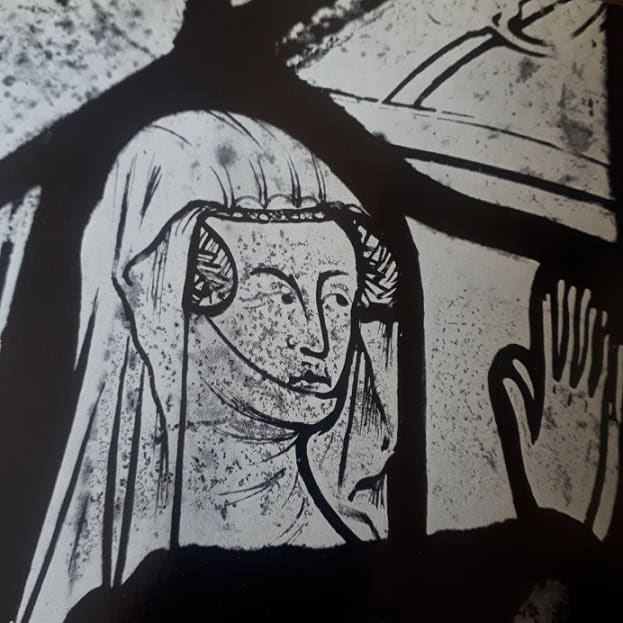
An article from The Sphere, dated September 16th, 1922, records that a medieval stained glass window was discovered when cement and building rubble was removed that covered a window between the Vestry and Lawrence Chapel. Francis Eeles, a renowned stained glass expert, identified the window as made between 1320-1340, the oldest window in London apart from Westminster Abbey. The window was sent to the V&A Museum with a plan to eventually restore it to Chelsea Old Church.
If the window had returned from the V&A before World War II, when the Church was bombed, it may have been destroyed. Enquiries made to the V&A confirmed they returned it in 1922, so it seemed that it had been destroyed in 1941. However, research at the British and Kensington libraries, and with stained glass experts, revealed that the Chelsea Society had paid for transferring the window to the crypt at St Luke’s in 1939 for safekeeping. An original search at Chelsea Old Church had not found the window but a more thorough search had found it sandwiched inside a broken 19th-century window in the Tower clock room. The window was now in 4 main parts, pictured below, plus many smaller pieces of glass.
The stained glass studio at Canterbury Cathedral has offered to restore/conserve the window; one option was to restore as found in 1922, and another to conserve the medieval parts only.
There was no head on the window discovered in 1922, so Maurice Drake drew up a full window restoration including a head very much in the William Morris style. However, his daughter took over the workshop and presumably provided her own interpretation with a head perhaps more medieval or even Matisse or Picasso in style.
Restoration
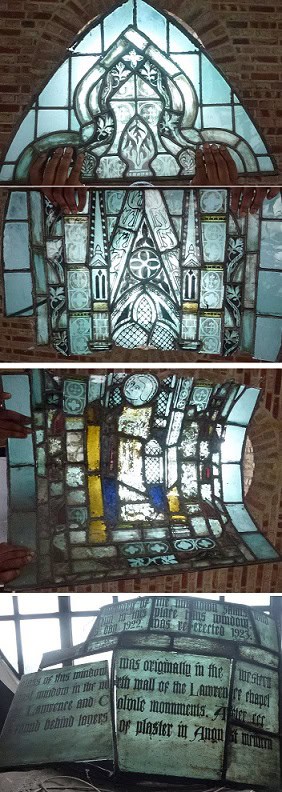
Window as found in 1922
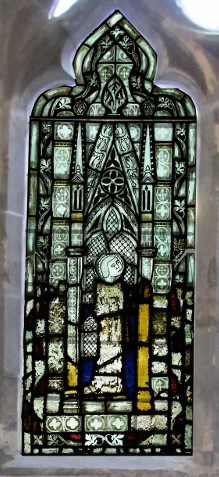
Option to restore complete window
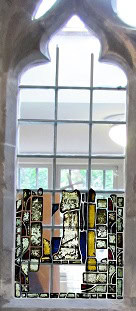
Option to just keep medieval part
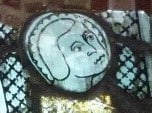
16th and 17th Century Windows
The Cartouche in the north window of the Lawrence Chapel is German or Flemish of the 16th century.
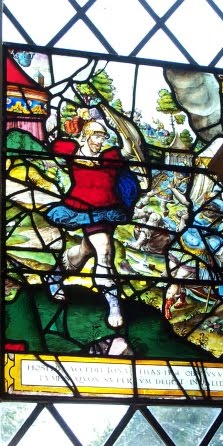
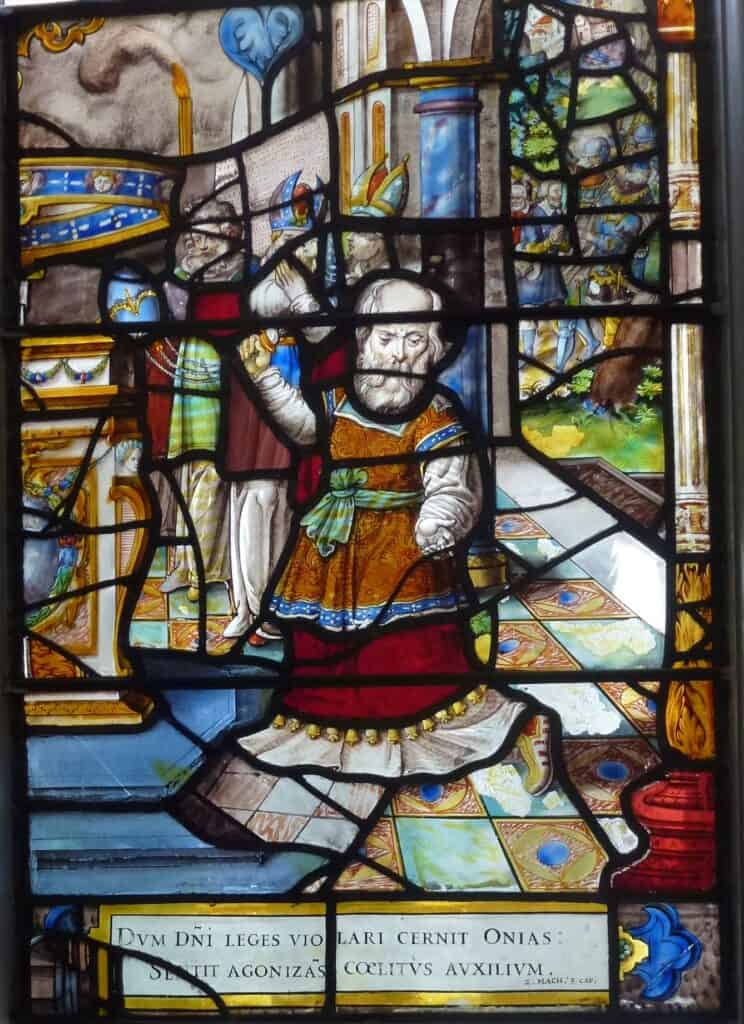
There are four 17th-century Flemish stained glass windows in the nave, a gift from Mrs Grosvenor Thomas in 1925. What story have they to tell? Dr Jasmine Allen, the director of the stained glass window museum wonders if they were from one of the many Carthusian monasteries or Charterhouses in the Low Countries. They were closed by the French revolutionary government in 1797 and contents were sold off mostly in France and England and later to the mansions of New York, including Fifth Avenue, to grace a vast mansion being built for ‘Copper King’ and US senator William Andrews Clark, for example. But now they are in museums and some returned to abbeys such as Park Abbey in Leuven in their original locations.
Unlike church windows, which are generally set high up and designed to be seen from a distance, the Park Abbey windows, for example, were at eye level. With their striking colours and finely painted detail, they were intended to be seen by the canons as they went about their duties, a daily reminder of their history and values.
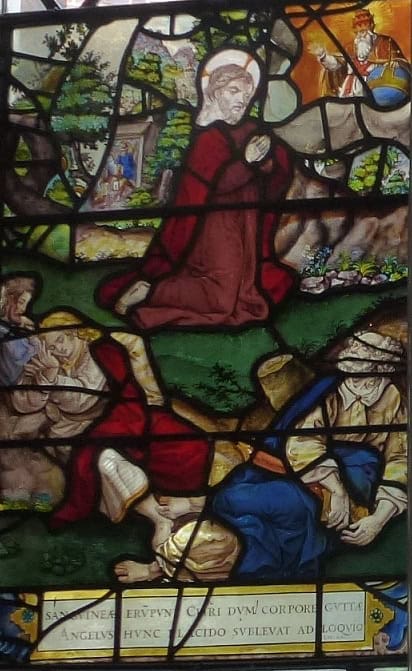
Translations of Latin inscriptions on each window:
Jonathan goes of his own accord to meet the enemy, whom light from above casts down strengthless.
Some of the letters are obscured by lead used to repair cracks so this is not a definitive translation.
While Onias sees the rules of the Lord being violated, he feels in his pain help coming from heaven. – 2 Macchabees, chap 3
Onias, the high priest at the Temple of Jerusalem, faces up to Heliodorus and his bodyguards, who were sent by Seleucus, King of Asia to claim the treasures stored in the Temple.
Agony in the Garden: While the bloody drops burst forth from the body of Christ, an angel removes him (or them) with gentle admonition. – Luke 22
The “Agony in the Garden.” Peter, James and John sleep while Jesus is encouraged by an angel as the arresting party approaches them. St Luke chapter 22 v39-46 especially 43 and 44